Choosing a window shade manufacturer is not a decision that should rest on price alone. For wholesale buyers, OEM brand owners, and project procurement teams, the real cost of a wrong supplier choice rarely appears on the initial invoice — it shows up in delayed shipments, inconsistent quality across batch orders, compliance failures at customs, and the operational burden of managing returns and re-orders.
This guide offers a practical, specification-level framework for evaluating window shade manufacturers before committing to a production partnership. Each section covers one core evaluation dimension, with specific questions and benchmarks you can use directly in supplier conversations.
Production Capacity: Can They Actually Deliver at Scale?
The first question any serious B2B buyer should ask is not "what products do you make?" but "can you reliably produce what I need, at the volume I need, without disrupting my supply chain?"
Factory Size and Dedicated Production Lines
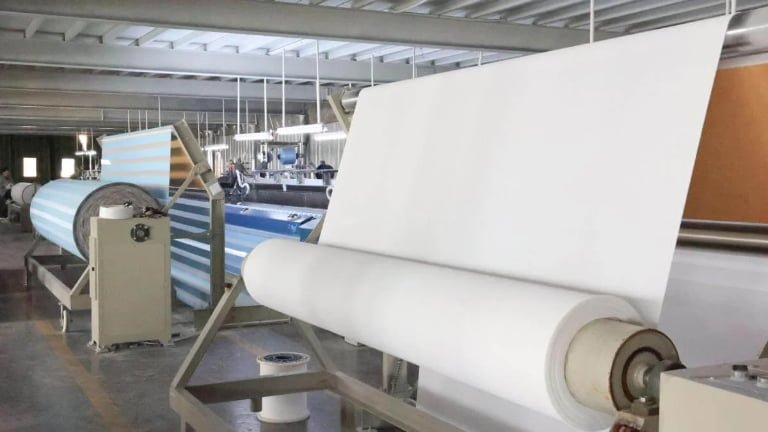
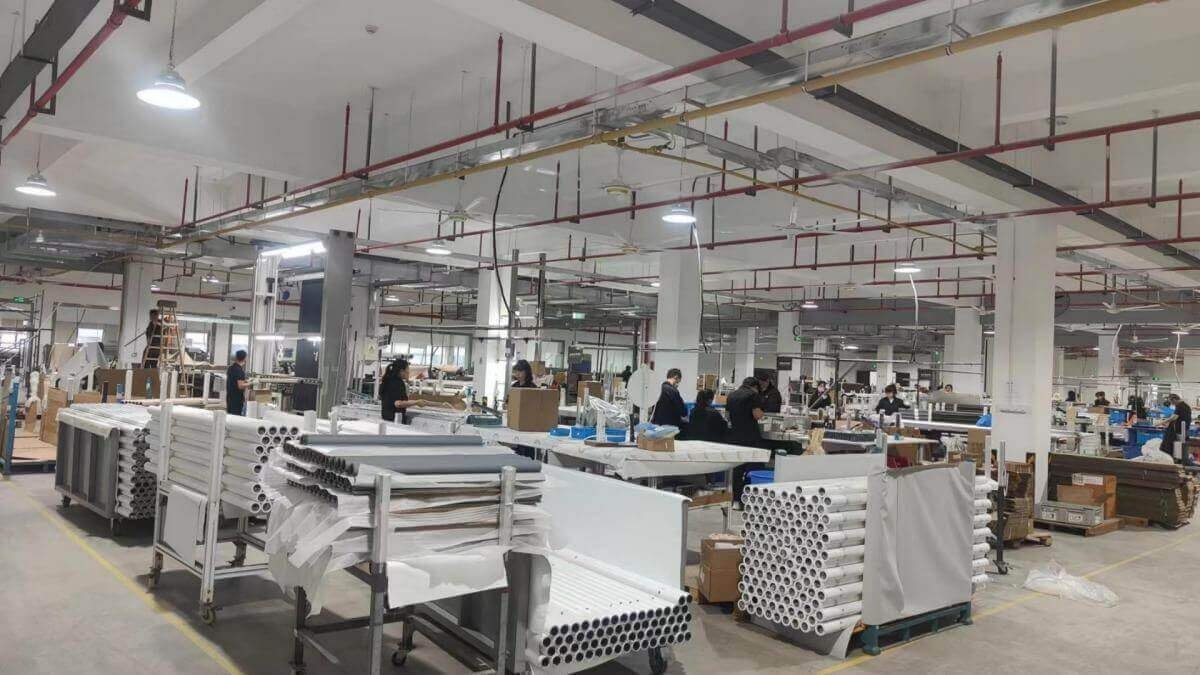
A manufacturer's physical footprint and line configuration are more reliable signals than claimed output figures. A factory with dedicated lines — each optimized for a specific product type (roller shades, cellular shades, motorized systems) — is operationally different from a general assembly operation that switches between product categories on shared equipment.
Key benchmarks to ask about:
- Total factory floor area (self-owned vs. leased matters — leased facilities carry operational continuity risk)
- Number of dedicated production lines per product category
- Machine count and automation level per line
For reference, Shadesmart operates a 58,883 m² self-owned factory in Xiamen with 12 dedicated production lines and 93 pieces of production equipment — a configuration that supports consistent throughput without product-category bottlenecks.
Annual Output as a Signal of Supply Reliability
Annual output figures tell you whether a manufacturer has the volume experience to handle your order without treating it as a stretch capacity event. A factory producing 11 million+ units per year has optimized its material flow, labor scheduling, and logistics handling to a degree that a 50,000-unit order does not represent an operational exception.
Ask specifically: What is your peak monthly output, and what is your average lead time during your highest-demand months (typically Q3, when global Christmas-season orders peak)? A manufacturer who cannot give you a clear answer to the second part of that question has not thought carefully about your supply chain.
Quality Control: What Happens Between Order and Shipment?
Production capacity means little without a quality control system that catches defects before they reach your warehouse. The critical distinction to make when evaluating manufacturers is between end-of-line inspection and multi-stage quality management — and why the former alone is insufficient.
The Four-Stage QC Model: IQC → IPQC → FQC → OQC
A robust quality management system for window shade manufacturing typically operates across four inspection nodes:
| Stage | Scope | Key Inspection Items |
|---|---|---|
| IQC (Incoming Quality Control) | Raw materials on arrival | Aluminum tube wall thickness, fabric weight (g/m²), color deviation (ΔE), hardware dimensions |
| IPQC (In-Process Quality Control) | During production | Cutting width tolerance (±1mm), height tolerance (±2mm), hem flatness — sampled every 2 hours per line |
| FQC (Final Quality Control) | Finished product | Full-cycle extension test ×3, operating force (≤25N per EN 13120 Class 1), blackout performance, visual inspection |
| OQC (Outgoing Quality Control) | Pre-shipment | Quantity verification, dimension label accuracy, packaging integrity |
Shadesmart's QC team comprises 16 dedicated quality staff executing 100% finished-product inspection before every shipment — meaning FQC is not a sampling process but a complete product review.
Why End-of-Line Inspection Alone Is Not Enough
A manufacturer that relies solely on final inspection has no mechanism to catch defects introduced mid-production. A cutting machine that drifts out of calibration between morning and afternoon shifts will produce an entire batch of incorrectly sized shades before a final inspection catches the error. In-process inspection (IPQC) is the only structural way to contain this risk.
When evaluating a supplier, ask: At what frequency do you inspect during production, and what is your process when an in-process defect is identified? A manufacturer without a clear answer to the second part of that question does not have a genuine corrective action loop in place.
Key FQC Items to Ask About
Three FQC items are particularly informative when assessing a shade manufacturer's technical rigor:
- Cycle testing: Does the manufacturer run a mechanical endurance test on finished products before shipment? For spring roller mechanisms, three full-cycle extension tests are a standard pre-shipment check. For motorized systems, limit position behavior under repeated cycling is the critical test.
- Operating force: EN 13120 Class 1 requires a manual operating force of ≤25N. Manufacturers who do not measure this are not calibrating their spring tension to a verified standard.
- Blackout verification: For products marketed as blackout shades, is the factory testing light transmission in a controlled environment (a dark box at 100 lux, with acceptable transmitted brightness ≤0.5 lux)? Or is "blackout" a fabric specification that does not account for installation-stage light gaps?
Technical Specification Knowledge: Does the Factory Understand Your Product?
A manufacturer who executes orders exactly as specified, without the technical knowledge to identify specification errors before production begins, is an execution partner — not a manufacturing partner. The distinction matters significantly for OEM buyers and project procurement teams.
Tube Diameter Selection: Weight, Not Just Width
One of the most common specification errors in roller shade production involves aluminum tube diameter selection. The correct basis for tube selection is the combined fabric weight and shade width — not window width alone.
The engineering logic: a 38mm diameter tube at 1,800mm width, carrying a heavyweight blackout fabric (e.g., 450 g/m²), will produce a mid-point deflection approaching 8mm. The visual acceptance threshold is ≤5mm; above this, fabric tension becomes uneven and wave patterns appear during operation. The correct specification for this configuration is a 50mm tube.
The question to ask a prospective manufacturer: If I specify a fabric weight of 400 g/m² at 2,200mm width, what tube diameter do you recommend, and why? A manufacturer who answers based on width alone — rather than walking through the weight-and-width calculation — does not have the specification knowledge to protect your product quality.
For reference, Shadesmart's standard specification rule defaults to 50mm tube diameter for any width exceeding 1,800mm, regardless of fabric weight, with further upward adjustments based on actual fabric load. This protects buyers who have not provided complete fabric specifications.
Batch Color Consistency: The ΔE Standard for Project Orders
For any order involving multiple shades across a single space — whether a hotel floor, an office fit-out, or a residential development — batch color consistency is a non-negotiable quality dimension.
Color deviation is measured using the CIE 1976 ΔE standard:
| ΔE Value | Visual Impact | Project Suitability |
|---|---|---|
| < 1.0 | Imperceptible to the human eye | Acceptable in all contexts |
| 1.0–2.0 | Detectable under careful observation | Requires client confirmation for same-room use |
| 2.0–3.5 | Visible at normal viewing distance | Not acceptable for same-room installation |
| > 3.5 | Clearly visible color difference | Not acceptable within a single project |
The primary cause of ΔE failures in project orders is mixing fabric from different production batches. A manufacturer with proper project-order protocols locks in fabric from the same machine, same dye batch before production begins, and pre-reserves a 15% safety margin for replacement needs.
Ask specifically: For a 200-unit project order, how do you manage fabric batch consistency, and what is your process if we need to reorder a single shade six months later?
Humidity Compensation for High-Moisture Markets
This is a specification dimension that almost no buyer asks about — and that separates manufacturers with genuine export market experience from those without it.
Non-woven polyester, the primary material for cellular shade fabric, expands and contracts with ambient humidity: approximately 0.2–0.3% width change per 10% change in relative humidity. For a shade produced at 50% RH in a factory environment and installed in a market where ambient humidity averages 80% RH — Singapore, coastal Australia, parts of the Middle East — the expansion at installation can be 15–20mm on a 2,400mm shade. That is the difference between a shade that installs smoothly and one that jams.
Manufacturers serving high-humidity markets should be able to describe their humidity compensation process: how they adjust production width targets based on destination market humidity profiles. If this question generates a blank response, the manufacturer has not done the engineering work for your market.
Supply Chain Transparency: What Goes Into Your Product?
For buyers exporting to Europe or North America, the materials inside a shade matter as much as the shade itself. Supply chain opacity is a compliance risk — one that surfaces at customs, not at the factory.
Aluminum Sourcing and REACH Compliance
Aluminum components in window shades exported to the EU must comply with REACH Regulation (EC) No. 1907/2006 SVHC requirements. The key threshold: lead content must not exceed 0.1% in aluminum alloy components.
Recycled aluminum is a common cost-reduction measure in shade manufacturing, but its variable composition — particularly elevated heavy metal content from mixed scrap sources — makes REACH compliance unpredictable when relying on supplier self-declaration alone. Primary aluminum (6063-T5 specification) offers stable chemical composition and reliable compliance, but commands a cost premium over recycled material.
The risk of non-compliance is not theoretical. REACH-related customs seizures of window covering products have occurred on EU-bound shipments where recycled aluminum components were sourced without independent chemical verification.
What to Ask: Periodic Testing vs. Supplier Self-Declaration
The difference between a supplier who manages this risk and one who does not comes down to one question: Do you conduct periodic independent chemical composition testing of your aluminum materials, or do you rely on your supplier's quality certificates?
A manufacturer managing this risk properly will:
- Source primary aluminum (not recycled) for export products
- Conduct quarterly or semi-annual independent chemical composition testing via a third-party laboratory
- Be able to provide test reports on request, not just supplier declarations
Shadesmart maintains this standard for export product aluminum sourcing. If a prospective manufacturer cannot produce a recent third-party material test report, the compliance risk transfers to the buyer.
Customization Depth and MOQ Flexibility
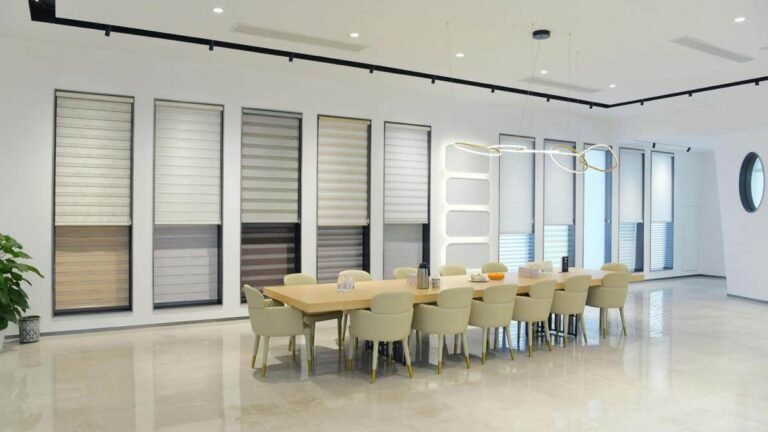
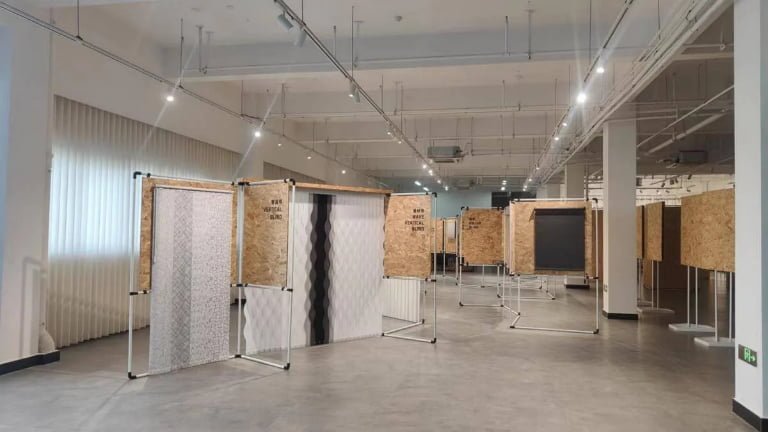
For OEM buyers and brand owners, the manufacturer's customization capability is often the deciding factor. But customization is not a binary — it exists on a spectrum, and understanding where a manufacturer sits on that spectrum is essential before discussing unit economics.
Three Tiers of Customization
A manufacturer with genuine OEM/ODM capability should be able to operate across three distinct tiers:
| Tier | Description | Typical Use Case |
|---|---|---|
| Light customization | Adjustments to standard products (branding, colorways, packaging) | Distributors establishing private-label lines |
| Sample development | Prototyping and functional testing of modified designs | OEM buyers validating a new SKU before committing to production |
| Deep customization | Project-level structural development, material optimization, IP protection agreements | Brand owners developing proprietary products; large-scale project procurement |
Shadesmart supports all three tiers, with a dedicated project manager assigned for deep customization and ODM engagements, and IP protection agreements available for new product development.
MOQ Structure: What 1-Piece MOQ Actually Means for B2B Buyers
Many manufacturers advertise 1-piece MOQ as a selling point. It is worth understanding what this actually means operationally.
A 1-piece MOQ on standard products means you can place a test order on an existing SKU without volume commitment — a genuine benefit for buyers evaluating a new supplier or validating product specifications before bulk commitment.
It does not mean that production-scale orders can be placed and fulfilled on the same timeline as a single-unit sample. Orders exceeding a certain volume threshold (typically 500+ units) require scheduled production runs with advance lead times. A manufacturer who implies otherwise is describing a fulfillment model that does not reflect production reality.
For Shadesmart: standard products are available at 1-piece MOQ; OEM custom orders start at 10 pieces; new product development and project orders are negotiated based on scope and production scheduling requirements.
Three Evaluation Dimensions Most B2B Buyers Overlook
The five dimensions above cover the foundational criteria most buyers consider. The following three are consistently underweighted — and tend to surface as problems only after a production relationship has begun.
Motor torque specification capability. For motorized shade orders, does the manufacturer size the motor based on fabric weight and drop height — or based on window dimensions? The correct basis is total mechanical load: fabric area × fabric weight (g/m²) + bottom rail weight + mechanical resistance allowance. A manufacturer who specifies motors by window size alone will systematically underpower shades carrying heavy fabric, resulting in motor overload failures in the field. Ask for the torque calculation methodology before placing a motorized order.
Humidity compensation documentation. As described in Section 3.3, high-humidity markets require production-width adjustments. But this only helps if the adjustment is documented and repeatable. Ask whether the manufacturer records the destination market humidity profile for each order and how that figure is translated into a production specification. A verbal "we adjust for humidity" is not sufficient; a documented calculation process is.
Limit position setup guidance for motorized shades. Incorrect limit position settings are among the most common causes of motorized shade motor failures in the field — and the failure mode is slow, cumulative, and almost always attributed to "motor quality" rather than installation error. Upper limit positions set too tight cause repeated short-duration motor overloads at the top of each cycle; lower limits set without adequate clearance cause repeated thermal shutdowns. A manufacturer who provides detailed, installation-specific limit position setup documentation is reducing your after-sales cost — not adding complexity.
Conclusion
Evaluating a window shade manufacturer across five core dimensions — production capacity, quality control depth, technical specification knowledge, supply chain transparency, and customization flexibility — gives you a structured basis for comparison that goes beyond price and product photographs.
The three overlooked dimensions in Section 6 are worth specific attention: they are the areas where the gap between a capable manufacturer and a merely compliant one becomes most visible, and where long-term partnership value is built or eroded.
Shadesmart is a factory-direct window shade manufacturer based in Xiamen, China, operating a 58,883 m² facility with 12 dedicated production lines and 11 million+ units of annual capacity. We support wholesale, OEM, ODM, and project procurement across 50+ countries, with 1-piece MOQ on standard products and full customization capability for brand and project buyers.
If you are evaluating Shadesmart as a manufacturing partner, we welcome sample requests and direct technical conversations before any production commitment. Contact us at info@shadesmart.com or call +86 151-6071-6597.
Frequently Asked Questions
What is the minimum order quantity for a window shade manufacturer? MOQ varies by order type. Standard products can typically be ordered in single units for evaluation purposes. OEM custom orders generally start at 10 pieces. New product development and large project orders are scheduled based on production capacity and scope, with lead times agreed in advance.
How do I verify the quality control process of a shade manufacturer? Ask the manufacturer to describe their inspection nodes beyond final shipment check. A multi-stage system (incoming material inspection, in-process inspection, finished product inspection, and outgoing inspection) indicates a structured QC process. Request specific metrics: cutting tolerance, operating force limits, and whether finished-product inspection is 100% or sampling-based.
What certifications should a window shade manufacturer have for export to the US and Europe? Certification requirements vary by product type and destination market. Key areas include fire retardancy (NFPA 701 for the US, EN 13773 for Europe), child safety cord compliance (ANSI/WCMA A100.1-2022 for the US), chemical compliance (REACH SVHC for Europe), and indoor air quality standards. Request documentation specific to your target market and product category from any prospective manufacturer.
How do I assess whether a motorized shade manufacturer supports smart home integration? Ask the manufacturer to specify which wireless protocols their motor systems support (RF 433/868/915MHz, Bluetooth, Wi-Fi/Tuya, Zigbee, Z-Wave) and which smart home ecosystems are compatible. Confirm whether compatibility is native or requires a third-party bridge. For commercial projects requiring building management system (BMS) integration, ask specifically about KNX or wired control options.