Sourcing window shades for a single home is a design decision. Sourcing them for a 200-room hotel, a multi-floor office building, or a portfolio of apartment units is a supply chain decision — and the two require different evaluation criteria entirely.
When you're ordering a commercial roller shades manufacturer's product at scale, the questions that matter aren't "does this look good in the showroom." They're closer to: will unit 214's shade match unit 12's shade after both ship from different production batches? Will the motor still be rated for the fabric weight you actually chose? Will quality control catch a sizing error before it reaches your job site, or after your installer is already on a ladder?
This guide walks through the evaluation points that actually separate a manufacturer capable of handling large-scale commercial orders from one that's simply good at retail — drawn from what our production team has seen go wrong on the factory floor, not just what looks good on a spec sheet.
The Batch Consistency Problem Most Buyers Don't See Coming
Here's a scenario that plays out more often than manufacturers like to admit: a hotel orders shades for 80 rooms, one room's measurements come in wrong during installation, and by the time a replacement is needed, the original fabric batch has sold out. The replacement comes from a new dye lot. The color difference isn't dramatic on its own — but sitting next to the original in adjoining rooms, it's visible enough that a guest could notice, and quality inspectors definitely will.
Color consistency between fabric batches is measured using a standard called Delta E (ΔE), from the CIE 1976 color difference formula. It's a useful framework for buyers to understand:
- ΔE below 1.0 — invisible to the human eye. Acceptable in any context.
- ΔE of 1.0–2.0 — detectable on close inspection. Should be avoided within the same room; flag it if it appears across different rooms in the same project.
- ΔE of 2.0–3.5 — visible under normal viewing conditions. Not acceptable within the same room; requires client sign-off even across different rooms.
- ΔE above 3.5 — an obvious mismatch. Should never appear within a single project.
The practical takeaway for large orders: ask your supplier how they manage batch production for projects over roughly 30 units. A manufacturer with a real process will tell you they produce from a single dye lot on the same production line, and that they order extra fabric — often around 15% over the calculated need — specifically to cover damage or measurement errors without forcing a mismatched reorder later in the project.
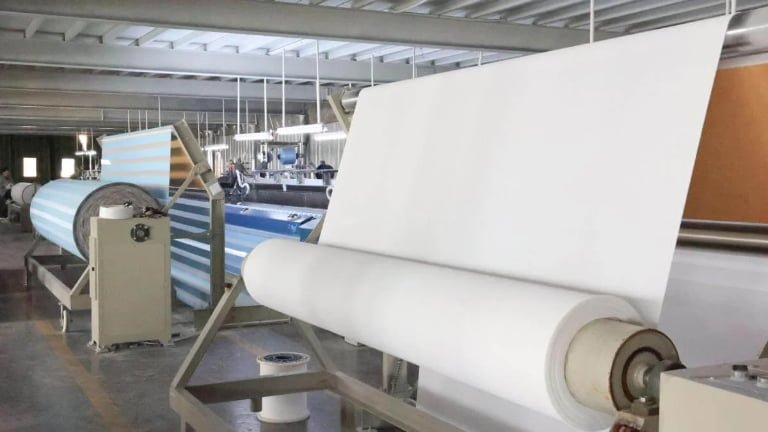
This is where vertically integrated manufacturing — producing fabric, components, and finished goods under one roof rather than assembling from multiple outside suppliers — genuinely matters for commercial buyers. It doesn't just mean tighter quality control; it means a manufacturer can trace and manage batch consistency across an entire large order instead of depending on whichever external supplier happens to have stock that week.
It's also worth knowing that consistency problems like this are usually solvable with the right equipment investment, not just tighter inspection. In our own production, upgrading looms with tension sensor feedback control to hold fabric alignment steady during weaving — the kind of investment that only pays off at scale — measurably tightened tolerances and lifted pass rates on wide-format striped fabrics well into the high 90s. That's the sort of infrastructure question worth asking a manufacturer directly, rather than assuming "we're careful" is the same thing as having a system for it.
Sizing Motors and Tubes: The Math Behind Reliable Large-Format Shades
One of the most common mistakes in commercial shade specification isn't a design choice — it's a math error. Buyers and even some installers tend to size tubes and motors based on window dimensions alone, without factoring in fabric weight. That's backwards, and it's the root cause of a surprising number of warranty claims.
Take tube selection. A 38mm aluminum tube is rated for widths up to roughly 1,800mm — but only for fabrics under about 200 g/m². Install a heavier 250 g/m² blackout fabric on that same 1,800mm width, and the tube's midpoint deflection lands around 4.2mm — borderline acceptable initially, but aluminum tubes creep under sustained load. What starts as a 4mm sag can become 6–7mm within a year, showing up as visible fabric rippling that customers report as a defect months after installation, not at delivery.
Motor selection follows the same logic. A shade's actual load isn't just window size — it's fabric area × fabric weight, plus bottom rail weight, plus a small mechanical resistance factor. A 2,400mm × 2,200mm blackout shade using standard 280 g/m² fabric works out to roughly 2.2kg of total load — well within a motor rated for 6kg. Swap in a heavier 450 g/m² fabric on the same dimensions, and that load jumps to over 3kg, which can exceed a motor only rated for 3kg. Same window. Different fabric. Different motor requirement entirely.
The question worth asking any manufacturer: do you size motors and tubes based on fabric weight, or just window dimensions? If they can't answer with a specific weight threshold, that's worth noting.
What Quality Control Actually Looks Like on the Production Floor
"We take quality seriously" is a claim every manufacturer makes. What's more useful for a commercial buyer is understanding what an actual inspection process covers, because that's what determines whether problems get caught before they ship or after they're installed.
A properly structured commercial-grade production process typically includes four distinct checkpoints:
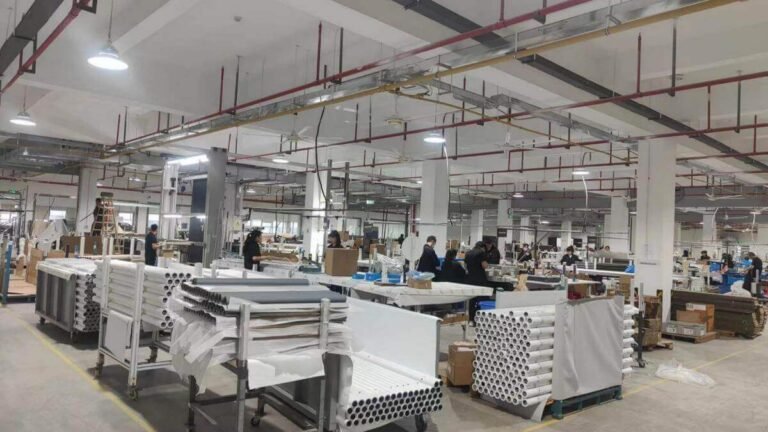
- Incoming material inspection — checking aluminum tubes, fabric, and hardware components against spec (dimensions, chemical composition for metal parts, fabric weight, color match) before they enter production.
- In-process inspection — checking cutting precision and hem quality during production, typically at set intervals throughout each shift.
- Finished product inspection — testing every completed unit through a full extension cycle, checking operating force, and verifying light-blocking performance for blackout products.
- Outbound inspection — verifying quantities, labeling accuracy, and packaging protection before the order ships.
Shadesmart runs this exact four-stage structure with a 16-person dedicated quality control team, and every finished unit — not a sample percentage — goes through final inspection before it leaves the factory. In our experience, the defects that actually reach a customer are almost never the dramatic ones; they're the small stuff that a rushed or partial inspection process lets slip through — a hem that's a millimeter off, a bottom rail with a slight bow that only shows up once it's hanging under its own weight. That's exactly what a 100%-inspection standard exists to catch. For commercial buyers, the relevant question isn't whether a supplier claims to have quality control. It's whether every unit is checked, or just a batch sample.
Where Roller Shades and Cellular Shades Fit in Commercial Projects
Not every commercial space needs the same shade type, and matching the product to the use case matters more than defaulting to whatever's cheapest per unit.
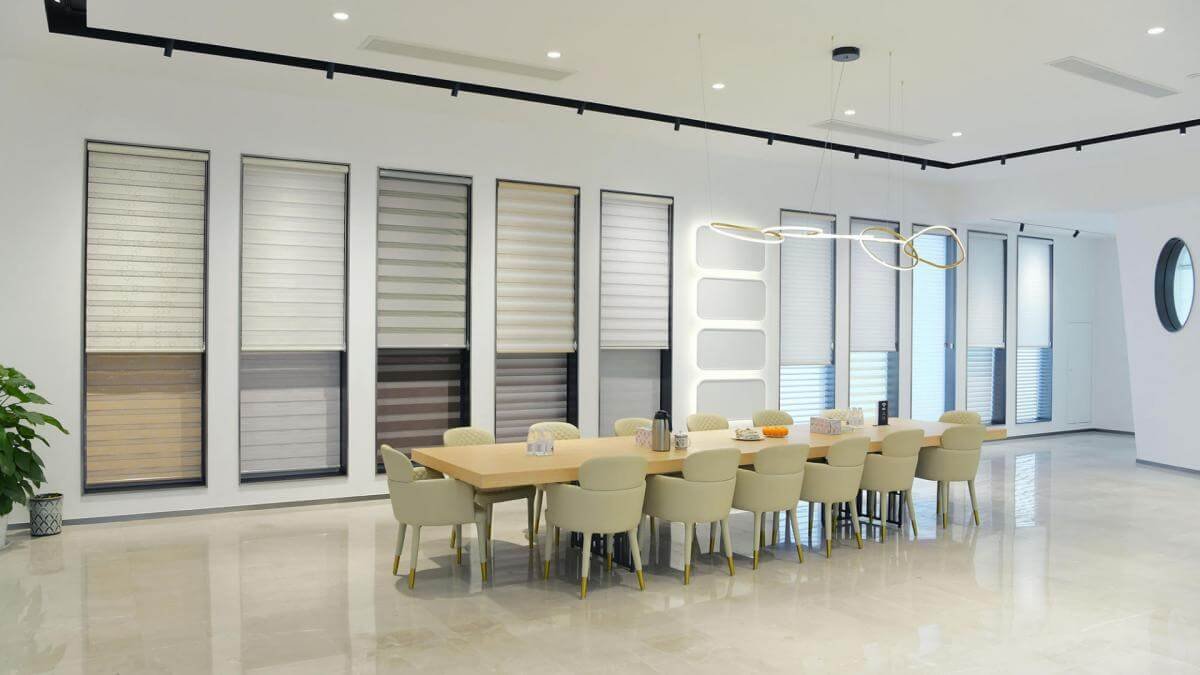
Roller shades remain the most straightforward fit for most commercial applications — offices, hotel corridors, retail spaces — where the priority is glare control, a clean look, and straightforward maintenance. Motorized versions add scheduling and remote control, useful for spaces that need shades opened and closed on a consistent daily rhythm without staff intervention.
Cellular (honeycomb) shades bring a different value proposition: measurable insulation performance. The R-value of a cellular shade depends heavily on its cell structure — a single 25mm honeycomb typically delivers an R-value in the 1.8–2.4 range, while a double 38mm honeycomb structure can reach 3.4–4.2. That's a meaningful difference for buildings trying to manage heating and cooling costs, particularly older commercial buildings that haven't been upgraded to low-E double glazing, where the improvement from adding cellular shades tends to be most noticeable.
For projects blending both — say, an office building using roller shades in open work areas and cellular shades in conference rooms or executive offices — a manufacturer capable of producing both product lines to consistent quality standards under one roof simplifies vendor management considerably compared to sourcing from separate suppliers.
Being Honest About What Doesn't Work
A supplier willing to tell you what their product isn't good for is usually more trustworthy than one that positions everything as a fit for every application.
A few honest limitations worth knowing before you specify:
- Roller shades without side channels are not true blackout, regardless of how the fabric is marketed. Fabric alone can block over 99% of light, but without a side channel system closing the gaps between the shade and the window frame, light leaks in around the edges — often enough to be clearly visible in a genuinely dark room. If a project requires true blackout (hotel rooms marketed on sleep quality, for instance), the side channel and cassette housing aren't optional add-ons — they're part of the spec.
- Cellular shades have real gap limitations too. Their thicker cell structure means a small but real gap forms along the sides in inside-mount installations — typically a few millimeters per side. It's not noticeable under normal room lighting, but for a space that genuinely needs theater-level darkness, a blackout roller shade with side channels will outperform a cellular shade every time.
- Cellular shades aren't the easiest option for high-dust, high-turnover environments like hotel rooms. They can't be wiped down with a damp cloth — moisture distorts the open-weave fabric structure — which makes them a better fit for offices and residential settings than for hospitality housekeeping routines.
None of this means either product is a poor choice. It means the right choice depends on what a space actually needs, and a manufacturer who explains the tradeoffs upfront is doing you a favor before the order ships, not after.
What to Ask a Commercial Window Shade Manufacturer Before You Order
Before finalizing a large commercial order, it's worth getting straight answers to a short list of questions:
- How do you manage color consistency across production batches on orders over roughly 30 units?
- Do you size tubes and motors by fabric weight, or just by window dimensions?
- What does your quality inspection process actually check, and does every unit get inspected or just a sample?
- Which product — roller or cellular — actually fits the light control and maintenance needs of this specific space, and why?
- What are the real limitations of the product you're recommending?
A manufacturer that can answer these specifically, rather than in generalities, is usually one capable of handling the scale and consistency a commercial project demands.
Shadesmart supports project and contract buyers with vertically integrated manufacturing — from fabric and component production through finished assembly — across roller shades, cellular shades, and their motorized variants. If you're planning a large-scale commercial order, get in touch through our Project & Contract Buyers program to discuss your specifications.