

Full article
You measured the window correctly. The factory cut to your order. The shade arrives and it jams in the opening. Before you blame the tape measure or the cutting table, check the humidity at the site.
I'm the production director at Shadesmart, a brand of Xiamen Goodwood Industry Co., Ltd. I started in window coverings in 2006 and joined the company in 2008, so I've spent almost two decades on this. A 16-person QC team checks every finished shade we ship, and I see how often a "sizing problem" is really a conditions problem. This article gives you a formula you can run yourself, shows where it breaks down, and tells you what to send a factory before you order for a humid site.
Can humidity really change the width of a window shade?
Yes. In our experience, non-woven polyester fabric, the mainstream fabric for cellular shades, changes width by about 0.2–0.3% for every 10% change in relative humidity. The change is small enough that nobody notices it on the cutting table.
Most sizing complaints get blamed on the measurement or on the cut, and that is a reasonable first guess. In our internal complaint data for 2019–2024, cutting-size deviation was the largest single cause, at 34% of returns and complaints. When we moved our cutting-machine calibration from weekly to every shift, that category dropped by 62%. We hold width tolerance to ±1mm at in-process inspection, and anything cut more than ±2mm off goes back to the workshop.
So cutting accuracy is a real factor, and we manage it. But a shade that left our factory within ±1mm can still arrive too wide for the opening if the factory and the site are at very different humidity levels. A calibrated cutter can't fix that, because the fabric changes after the cut.
This applies to the fabric we've worked out the numbers for. I don't have an equivalent humidity coefficient for our roller shade fabrics. If you are buying wholesale roller shades for a humid site, don't apply the figures below to them. Ask us for site-specific guidance instead.
How do I calculate the width change for my site?
The estimate is: width change = shade width × (0.2–0.3%) × (humidity change ÷ 10).
The humidity change is the difference between the factory conditions (where the shade was cut) and the site conditions (where it will hang). Use 0.2% for the low estimate and 0.3% for the high one. This is a rule of thumb we built from production experience, not a published engineering standard, so treat it as an estimate and not a guarantee.
Here is a worked example. Take a window opening 2,400mm (94.5 in) wide. We produce the shade at 2,388mm (94.0 in), leaving 12mm (0.47 in) of total clearance. The shade is made at about 50% relative humidity and installed in an apartment at 80%. That is a 30-point swing.
Table 1. Width growth for a 2,388mm shade as site humidity rises above factory conditions
| Humidity rise | Growth at 0.2% per 10 points | Growth at 0.3% per 10 points | Clearance left (of 12mm), low / high estimate |
|---|---|---|---|
| +10 points | ~4.8mm | ~7.2mm | ~7.2mm / ~4.8mm |
| +20 points | ~9.6mm | ~14.3mm | ~2.4mm / ~-2.3mm |
| +30 points | ~14.3mm | ~21.5mm | ~-2.3mm / ~-9.5mm |
At the full 30-point swing, the shade grows to roughly 2,402mm at the low estimate and about 2,409mm at the high estimate. Either way, a shade made 12mm narrower than the opening ends up wider than the opening. Negative clearance means the shade is physically too wide to sit in the frame, and you get the sticking, rubbing, and forced installs that end up as callbacks.
The 12mm of clearance was used up after about a 17-point rise at the high coefficient, or about 25 points at the low one. That is not an extreme swing for a humid climate.
Why does it matter more on inside-mount installs in coastal Australia and Canada?
Inside mounts leave no room to absorb growth. The shade sits between the jambs, so any width the fabric gains comes straight out of the clearance you planned.
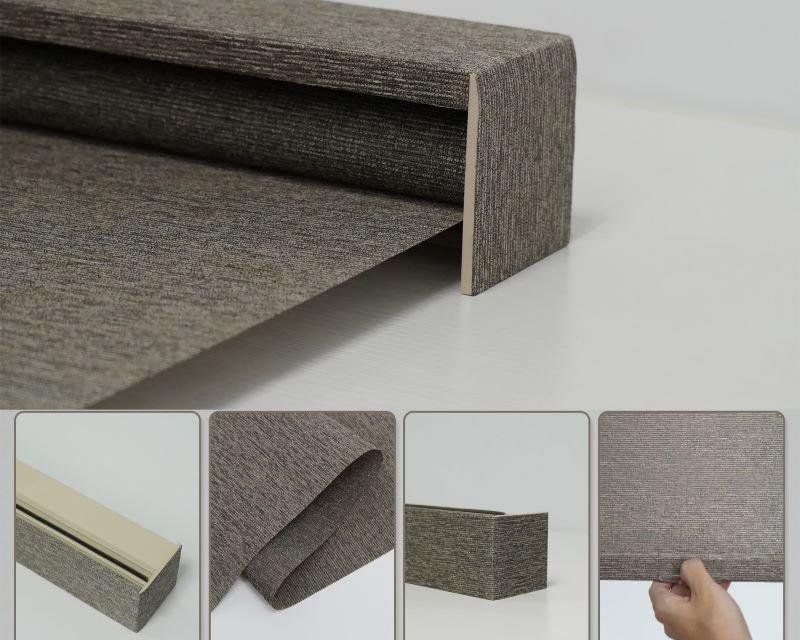
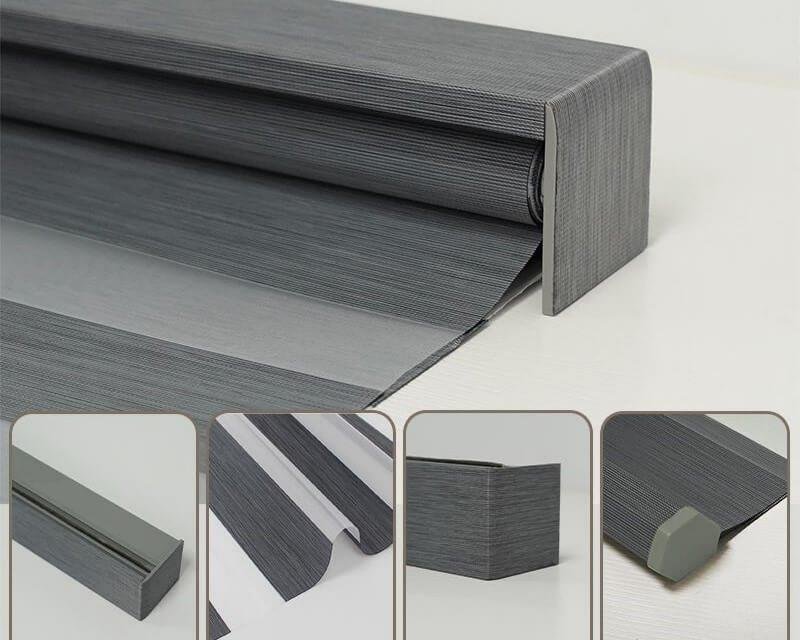
A cellular shade is also thicker than a flat roller shade. In our experience, the usual gap between the shade body and the window frame at each side is about 3–8mm. You want that gap to be small so light doesn't leak around the edges. But a small gap is also all the room the fabric has to grow into.
Table 2. Roughly how much humidity rise a given side gap can absorb (2,388mm shade, simple model)
| Gap per side | Total clearance | Humidity rise absorbed, high estimate (0.3%) | Humidity rise absorbed, low estimate (0.2%) |
|---|---|---|---|
| 3mm (0.12 in) | 6mm | ~8 points | ~13 points |
| 5mm (0.20 in) | 10mm | ~14 points | ~21 points |
| 8mm (0.31 in) | 16mm | ~22 points | ~33 points |
The model is simple. It assumes the shade is made to the opening width minus both gaps and that growth is spread evenly across the width. Real installs have uneven frames, out-of-square openings, and brackets that eat into the gap. The table shows the order of magnitude and should not replace a site check.
Here is how this plays out for the two regions in the title.
- Coastal Australia. Sites near the coast can sit at high humidity for much of the year. If the shade is made in a drier environment, you can see the full humidity gap shown above. If you install in this region, our Australia and New Zealand market page covers how we support local distributors and installers.
- Canada. I'd expect more variation from building to building and season to season, depending on the HVAC system and whether the building is ventilated. A shade ordered in one season can be installed in another, so it is worth asking what the site conditions will be on installation day and over the following months. Our Canada market page has the wholesale details for that market.
I'm not giving you humidity figures for either region. A postal code or a climate map can't tell me what the air is like inside a given room, which is why I ask for site data instead.
My numbers cover only the humid-site direction (humidity higher at the site than at the factory). I haven't validated figures for the opposite case, so I won't offer any here.
What do we do differently for high-humidity projects, and what are the limits?
For humid-site projects, we stop relying on the standard sizing allowance and work from the site's conditions instead. We ask for the monthly average temperature and humidity at the install location, and we use that data to recalculate the production width. For high-end commercial and project work, this is a required step in our process, not an optional extra. It is our internal practice and not an industry requirement.
The limits are worth stating plainly.
- The coefficient is an empirical rule of thumb. It comes from our production experience with non-woven polyester. It is not a standard formula, and the real figure varies with the fabric weight, the weave, and the coating.
- It only covers the fabric we have data for. I won't apply the 0.2–0.3% figure to roller shade fabrics, to natural fibers, or to anything else without separate data. Other materials change in other ways. Linen and bamboo, for example, move because of heat shrinkage, which is a different mechanism, and we don't motorize them for that reason.
- We can't predict site humidity from an address. Without data from the actual building, any sizing adjustment is a guess. We would rather ask for the data than guess.
- Sizing allowance isn't the only thing that decides whether a shade fits. Frame squareness, bracket position, and measurement accuracy still count. Humidity is one variable among several, and it is easy to overlook.
What should I send the factory before ordering?
Send us the actual measured width of each opening, the mounting type, and the monthly average temperature and humidity at the site. That is enough for us to size the shade for its working environment, not just for the factory floor.
A short checklist:
- Measured width and height for each opening, in millimeters (or inches, and tell us which)
- Inside mount or outside mount
- Monthly average temperature and relative humidity at the install location
- Whether the building is air-conditioned or heated, and whether it is occupied yet
- The fabric you are ordering, so we can confirm whether we have sizing data for it
If you are working on a humid-climate project and haven't collected site humidity data, tell us. We would rather have that conversation before production than after installation.
Planning a humid-climate order? Send us your opening sizes and site conditions and we'll tell you whether we have sizing data for your fabric before you commit. For stock and trade terms, see our wholesale program.
Frequently asked questions
Can humidity make a cellular shade too wide to fit?
Yes, on inside mounts with small clearances. In our experience, non-woven polyester changes width by about 0.2–0.3% per 10% change in relative humidity, so a large gap between factory and site humidity can use up the clearance. Tight installs are the ones that jam.
How much clearance should I leave for humidity?
It depends on the humidity gap between factory and site, and on the fabric. Use the formula above: width × (0.2–0.3%) × (humidity change ÷ 10). I don't give a single fixed number because the right allowance changes with site conditions, and the coefficient is a rule of thumb, not a standard.
Do roller shades change width with humidity the same way?
I can't say. Our 0.2–0.3% figure comes from non-woven polyester cellular shade fabric. We don't have an equivalent coefficient for roller shade fabrics, so please don't apply it to them. Ask us for site-specific guidance.
What site information should I send before ordering shades for a humid location?
Measured opening width and height, mounting type, monthly average temperature and relative humidity, whether the building is heated or air-conditioned, and the fabric you want. Our factory-direct team can then size the shade for its working environment.
Ready to Source Direct?
Ready to Talk About Your Project?
Send us your product specifications, target market, and estimated volume. Our export team responds within 1 business day.