Shine a white LED flashlight through the fabric. On a woven zebra shade, the boundary between the see-through and blocking stripes is sharp, and magnification shows a clear thread-density difference. On a printed one, the boundary fades gradually and the weave looks uniform. It takes about two minutes and no lab equipment.
I've worked in window coverings since 2006 and joined Xiamen Goodwood Industry in 2008, so I have seen a lot of zebra shade samples cross a factory table. If you are comparing zebra blinds manufacturers or sourcing zebra blinds wholesale, this test is the first thing I'd do with any sample. (A quick note on terms: in sourcing conversations "blinds" is often used as a catch-all. The product in this article is the zebra shade, a dual-layer roller-style product.)
What is the difference between a woven and a printed zebra shade?
A woven zebra shade has its stripes built into the fabric on the loom. A printed one has stripes added as ink on a fabric that is otherwise uniform. The two can look identical on a product page and behave very differently over time.
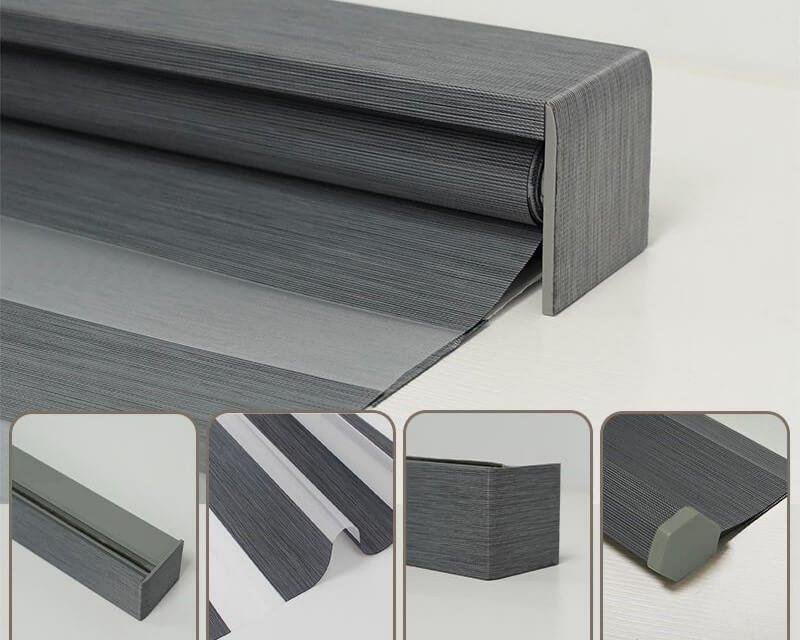
In a genuinely woven zebra fabric, the light-transmitting stripes (an open, mesh-like structure) and the blocking stripes (a dense weave) alternate across the same piece of cloth. They are not printed and not stitched together. The difference is structural, created on the loom. In a printed version, the fabric is uniform and the stripe pattern is only a difference in ink depth.
This matters commercially because a printed shade can pass as a woven one in photos, spec sheets, and even a quick handling of the sample. Sample-stage price gaps between suppliers are often a sign that you are comparing two different constructions.
How do you do the flashlight test, step by step?
Hold a swatch up to a white LED light and look at the stripe edges, first with the naked eye and then magnified. The stripe boundary and the thread density tell you which construction you have. A white LED flashlight works best.
- Take a swatch or a full sample of the fabric you want to check.
- Shine a white LED flashlight through the fabric and look at it from the other side, so the light is transmitted through the cloth.
- Look at the boundary between the light-transmitting stripe and the blocking stripe. Is the edge sharp, or does it soften gradually?
- Look at it magnified. Compare the thread density inside the light stripe and inside the blocking stripe.
- Compare against the table below.
| What you check | Woven stripes | Printed stripes |
|---|---|---|
| Boundary between light and blocking zones | Clear, sharp edge | Feathered, gradual fade |
| Thread density under magnification | Visibly different between the two stripe types | Same across the whole fabric |
| What creates the stripe difference | Loom structure: open mesh vs. dense weave | Ink depth only |
If the results are mixed, such as a mostly sharp edge on one side and a soft one on another, I'd treat the sample as unverified and ask the supplier for the fabric construction in writing.
What happens to a printed zebra shade after 18–36 months?
In our experience, printed zebra shades typically last about 18–36 months in the market. Fading and color bleeding tend to show up first at the edges of the light-transmitting stripes, where sunlight passes through most directly.
That is a rule of thumb from what we see, not a lab-tested industry figure. The pattern makes sense: the stripe difference exists only in the ink, so the ink is the part that ages. Under strong light, the transmitting stripes take the most exposure, and the edge where ink meets bare fabric is where degradation becomes visible first.
I don't want to overstate this. Printed shades exist for a reason: they cost less to make, and they mostly go to low-price e-commerce channels. The real risk is not the printed product itself; it's a printed product sold as a woven one. A wholesaler who buys a large order believing the shades are woven, and finds out 18 months later, has a return problem and a customer-trust problem.
What should you ask for once you know it's woven?
Passing the flashlight test only proves the stripes are woven. It does not prove the fabric is good. A woven zebra fabric can still be light, coarse, or prone to fading. Once you've confirmed woven construction, ask the supplier for these four specifications in writing:
| Parameter | Shadesmart standard | Low-end market products |
|---|---|---|
| Base yarn fineness | 150D–300D polyester | 75D–100D |
| Blocking-stripe weight | 220–280 g/m² | 150–180 g/m² |
| Light-stripe hole density | 65–85 holes/cm² | 40–60 holes/cm² |
| Color fastness (ISO 105-B02) | Grade 6 or higher | Grade 4–5 |
The color fastness row refers to the ISO 105-B02 lightfastness test method1, so when a supplier quotes a grade, ask which method and which report it comes from.
This is our internal standard, not an industry requirement. The right column describes what we typically see at the low end of the market, not a formal category. You should hold every supplier, including us, to the same request: the numbers, and ideally a test report for the color fastness result.
Here is the limit of the flashlight test. You cannot see yarn fineness, fabric weight, or color fastness with a flashlight. A sharp stripe edge tells you how the fabric was made. It does not tell you which column of that table the fabric belongs in. That is why we don't rely on visual checks alone on our side. Incoming fabric goes through incoming quality control, where we check fabric weight and color difference, and finished products are inspected by our 16-person QC team before shipping, with 100% of finished shades inspected. You can read more on our quality control process.
Stripe alignment accuracy across wider widths is another quality dimension that separates suppliers. I'll cover it separately.
When is a zebra shade the wrong choice, even if it's woven?
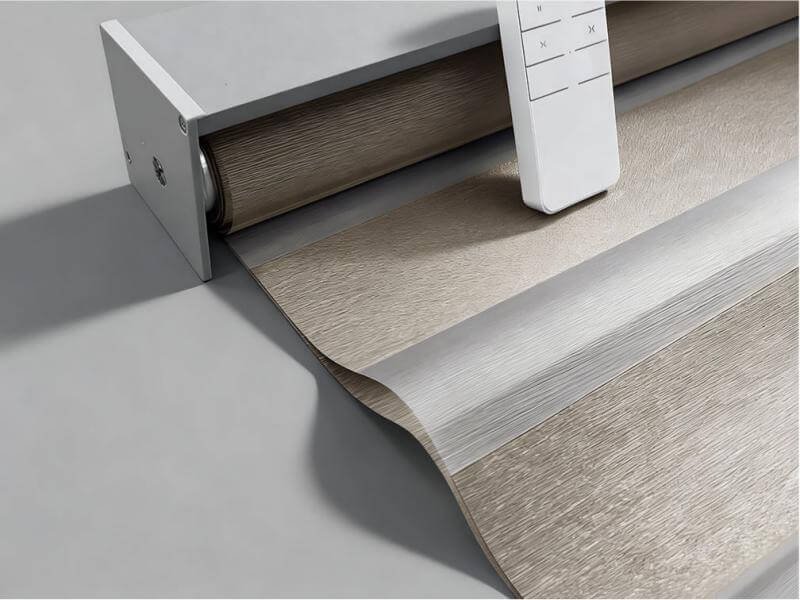
Zebra shades cost more to maintain than roller shades, especially in dusty environments. If low maintenance matters more than fine light control, a roller shade is usually the better product. This is the part of the conversation many suppliers skip.
Zebra fabric can't be wet-wiped, because moisture distorts the open weave and can permanently shift the stripe position. It can't go in a washing machine, and solvent-based cleaners can damage fabric coatings and dye stability. The workable cleaning routine is a low-suction vacuum with a soft brush (roughly monthly in a dusty setting), compressed air for commercial spaces, or a dry cloth sheet with no moisture.
In kitchens, near construction, or in cities with poor air quality, that maintenance load adds up. For hotel guest rooms in particular, I recommend roller shades over zebra shades. The hidden housekeeping cost is what procurement managers regret later. Zebra shades suit offices and homes better, where the light-control benefit is actually used and the cleaning routine is realistic.
If your project is a hotel fit-out or a high-dust site, roller shades are usually the better fit, and we'll tell you so plainly. If you want softer, diffused light rather than stripe-based light control, our Sheer Shades use a different construction: a soft sheer fabric combined with horizontal vanes.
Ready to check a sample yourself?
If you are an online seller or a small retailer, you can start with a single piece: standard products are available from 1 piece, so you can run the flashlight test on a real zebra shade before committing. Request a 1-piece sample before you commit.
One honest boundary: a 1-piece minimum is for testing. Orders above 500 pieces are produced on a planned schedule, and we can't promise next-day shipping on them. If you are planning volume, see how zebra blinds wholesale works and how we set up trade accounts.
FAQ
How can I tell if a zebra shade is printed?
Shine a white LED flashlight through the fabric and look at the stripe edges. A printed stripe has a feathered, gradual boundary and uniform thread density under magnification. A woven stripe has a sharp boundary and visibly different thread density between the light and blocking stripes.
Is a woven zebra shade always better than a printed one?
Not automatically. Woven construction means the stripes are structural, but fabric quality still depends on yarn fineness, stripe weight, hole density and color fastness. Ask for those numbers in writing regardless of construction.
Can zebra shades be cleaned with water?
No. Moisture can distort the open weave and permanently shift the stripe position, and machine washing destroys the fabric structure. Use a low-suction vacuum with a soft brush, compressed air, or a dry cloth sheet instead.
Are zebra shades a good choice for hotel guest rooms?
In my experience, roller shades are usually the better choice for hotel rooms. Zebra shades take more cleaning effort in dusty environments, and that hidden housekeeping cost adds up across many rooms.
Can I order a single zebra shade to test before a bigger order?
Standard products are available from 1 piece for testing. Larger orders above 500 pieces follow a production schedule and can't be shipped the next day.
Follow this link to see what the ISO light-fastness test covers and how color fastness grades are determined. ↩