When buyers search "motorized blinds cost," they usually want one of two things: a ballpark retail price for a single window, or a framework for evaluating bulk procurement decisions. This guide is built for the second group — importers, distributors, hotel developers, and project buyers who need to understand what actually drives the price of motorized window shades before committing to a large-format order.
The short answer is that motorized blinds cost is not a single number. It is the sum of four compounding variables: motor selection, power supply method, control protocol, and fabric specification. Get any one of these wrong, and the savings you negotiated on unit price can disappear in warranty claims, site rework, or maintenance costs within 18 months.
This guide breaks down each factor with specific technical parameters, then closes with three budget misconceptions that routinely cause commercial projects to overspend.
Motor Selection — The Biggest Cost Variable You're Probably Underestimating
The most common motor selection mistake in bulk procurement is choosing torque rating by window size rather than by fabric load. Window dimensions tell you how large the shade needs to be. They do not tell you how heavy it is — and the motor does not care about dimensions. It cares about weight.
The correct selection logic follows a straightforward load calculation:
Actual load (kg) = fabric area (m²) × fabric weight (g/m²) ÷ 1,000 + bottom rail weight (kg) + mechanical resistance factor (0.3 kg)
To make this concrete: a motorized roller shade at 2,400mm wide × 2,200mm high, using a standard 280 g/m² blackout fabric and a 180 g/m bottom rail, produces an actual load of approximately 2.21 kg. A 1.5 Nm DC tubular motor with a maximum rated load of 6 kg handles this comfortably at 37% capacity — well within the recommended safety threshold of 70% maximum utilization.
Now change only the fabric. Upgrade to a 450 g/m² heavy blackout specification — common in Northern European export markets — and the same window produces a total load of approximately 3.15 kg. An entry-level 1.0 Nm motor rated to 3 kg maximum would be operating at over 100% capacity. That motor will fail under sustained use. The correct selection becomes the 1.5 Nm unit, and the cost difference between motor tiers typically runs 30–80% depending on specification.
The table below shows Shadesmart's standard DC tubular motor range with load and application parameters:
| Model | Rated Torque | Max Load | Max Recommended Width | Noise Level (@ 1m) |
|---|---|---|---|---|
| SS-DC1.0 | 1.0 Nm | 3 kg | 1,600mm | 35–40 dB |
| SS-DC1.5 | 1.5 Nm | 6 kg | 2,400mm | 36–42 dB |
| SS-DC2.0 | 2.0 Nm | 10 kg | 3,000mm | 38–44 dB |
| SS-DC3.0 | 3.0 Nm | 16 kg | 4,000mm | 40–46 dB |
| SS-AC5.0 | 5.0 Nm | 28 kg | 6,000mm | 48–55 dB |
Motor pricing varies by torque tier, quantity, and order configuration. Contact Shadesmart with your fabric specification and window dimensions to receive an accurate motor selection recommendation and project quote.
Power Supply — Upfront Cost vs. Total Cost of Ownership
Power supply choice shapes the full financial picture of a motorized blinds installation, not just the purchase invoice. The three available options — hardwired AC, rechargeable lithium battery, and solar — each have a different cost profile depending on how frequently the shades will be operated.
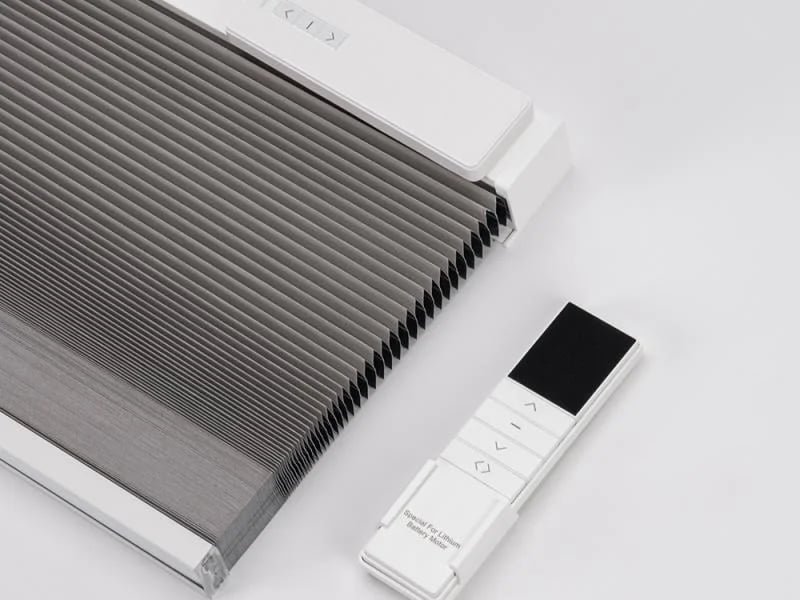
Rechargeable battery motors carry a lower upfront cost because they require no pre-wired power outlet at each window. For residential or low-frequency commercial installations, this is a genuine advantage. A standard 18650 lithium battery cell reaches its 500-cycle threshold — at which point capacity has declined to approximately 78–85% of original — after roughly five years at one to two operations per day. Maintenance pressure in this scenario is minimal.
The same 500-cycle threshold arrives in a very different timeframe at commercial usage rates. In a hotel guest room operating eight to fifteen cycles per day, 500 cycles accumulate in approximately eight to ten months. At that point, battery performance begins to degrade noticeably, and replacement or servicing becomes a recurring property management obligation.
Hardwired AC motors carry higher installation cost — pre-wiring must be in place before blinds are fitted, which is straightforward in new construction but adds cost in retrofit scenarios. For high-frequency commercial applications, however, the absence of battery maintenance cycles makes hardwired motors the lower total-cost option over a three-to-five-year horizon.
Solar-powered options are available for applications where neither wiring nor frequent charging is practical — outdoor-facing shades or hard-to-access locations. They represent a niche application rather than a default commercial choice.
Decision framework by use case:
| Scenario | Daily Operations | Recommended Power Supply | Rationale |
|---|---|---|---|
| Residential / low-frequency | 1–2 | Rechargeable battery | Low maintenance burden; no wiring cost |
| Office / moderate commercial | 4–6 | Rechargeable battery or hardwired | Evaluate based on retrofit complexity |
| Hotel guest rooms | 8–15 | Hardwired AC | TCO significantly lower over 3–5 years |
| High-rise or large-scale project | Varies | Hardwired AC | Maintenance scalability |
If you are evaluating motorized blinds for a hospitality or multi-unit residential project, ask your supplier for a total cost of ownership comparison across power supply options — not just a per-unit price. The difference in five-year operating cost can be substantial.
Control Systems — How Protocol Choice Affects Your Bill of Materials
The wireless control protocol embedded in a motorized shade system is one of the least visible line items in a procurement budget and one of the most consequential. Smart module costs vary by as much as three to five times across protocol tiers, and the wrong choice can require full system replacement if the terminal end-user's smart home infrastructure is incompatible.
The four main protocol tiers, in ascending order of system complexity and cost:
RF 433/868/915 MHz is the most cost-effective option for standalone remote-control operation without smart home integration. It offers a practical open-air range of 30–50 meters with reasonable wall penetration. The 868 MHz band (standard in EU markets) and 915 MHz band (US and Australia) offer better interference resistance than 433 MHz, which can experience channel conflicts in high-density residential buildings. This protocol tier suits residential and small commercial buyers who need reliable remote operation without platform integration.
Wi-Fi (Tuya / Smart Life platform) enables connectivity to major smart home platforms and voice assistant ecosystems. Material cost is moderate, and setup is accessible to non-technical end-users. The functional constraint is signal dependency: the module requires a 2.4 GHz Wi-Fi signal of at least −70 dBm at the window location. In large apartments or buildings with weak router coverage near windows, this can create dead zones that affect control reliability. For buyers sourcing shades destined for smart home retail channels, Wi-Fi integration compatibility with major platforms should be confirmed with Shadesmart's sales team before specifying.
Zigbee supports mesh networking, where each device extends the network to the next. This makes it the appropriate protocol for multi-room or whole-home installations where dozens of shades need to be managed as a coordinated system. Per-device module cost is higher than Wi-Fi, and the system typically requires a hub or gateway. For system integrators and smart home project buyers, Zigbee offers the most reliable large-scale deployment architecture.
KNX is the standard for commercial building automation — offices, hotels, and public facilities where window shades are controlled as part of a centralized building management system (BMS). KNX infrastructure cost is the highest of any protocol tier and is only justified at commercial project scale where the BMS is already in place or being specified as part of a larger fit-out.
The practical question for procurement is: what does the end-user's ecosystem actually require? Specifying a KNX-capable module for a residential buyer, or an RF-only module for a hotel BMS integration, both create avoidable cost problems — one by overspending on capability, the other by requiring a system retrofit.
Fabric Specs and Customization Depth — Where Costs Compound
Fabric specification is the variable that most directly determines which motor tier is required, which makes it upstream of several other cost decisions. A procurement team that finalizes fabric selection late in the project cycle can trigger motor re-specification, retooling costs, and delivery delays simultaneously.
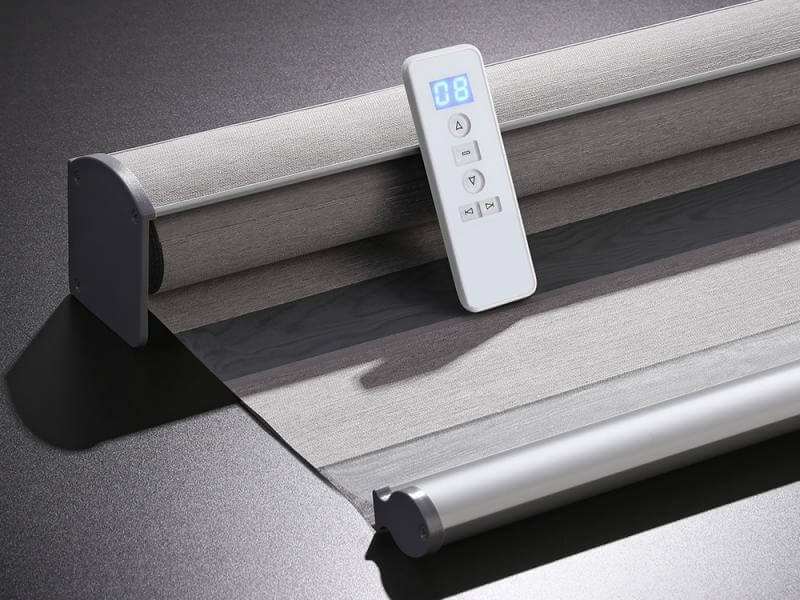
The standard weight range for residential roller shade fabrics runs approximately 100–250 g/m². Commercial blackout fabrics — particularly those destined for Northern European markets, hospitality applications, or cinema-grade installations — commonly run 350–450 g/m². Moving from a light residential fabric to a heavy commercial blackout specification on a 2,400mm-wide shade can shift the motor requirement from a 1.0 Nm unit to a 1.5 Nm unit, with corresponding cost implications as noted in the motor selection section above.
Customization depth introduces a separate cost dimension: lead time. Shadesmart operates a three-tier customization model:
- Light customization — adjustments to standard products (dimensions, color selection from existing range, hardware finish). Fastest lead time, lowest tooling cost.
- Sample development — prototyping and functional testing of modified or new configurations. Intermediate lead time; appropriate for new SKU validation before bulk commitment.
- Deep customization — full structural development with proprietary material optimization. Longest lead time; suitable for branded OEM programs and large-format project development.
For fabric specifically, lead time varies significantly by specification type. Standard in-stock fabrics are available for production within three to seven days. Custom colorways or proprietary specifications require 25–35 days for fabric sourcing before production can begin. On a project with a fixed site-readiness date, this lead time difference is a direct cost: either the project waits, or air freight replaces sea freight.
On order volume: Shadesmart's minimum order quantity is one unit for standard products and ten units for OEM custom orders. For large-volume or phased project orders, production scheduling is negotiated at order confirmation. Bulk orders require planned production slots — they cannot be inserted into an existing production queue without schedule impact.
3 Cost Misconceptions That Lead to Budget Overruns
These three errors appear repeatedly in commercial procurement cycles. Each is avoidable with the right specification process.
Misconception 1: Motor selection is driven by window size. Torque requirements are determined by total fabric load, not window dimensions. Selecting an undersized motor to reduce unit cost creates a predictable failure point. In high-cycle commercial applications, an overloaded motor can reach thermal failure within months, generating warranty replacement costs that exceed the original savings several times over. The correct process is to calculate actual load per window before specifying motor tier.
Misconception 2: Rechargeable motors are the low-maintenance option. Rechargeable motors reduce installation cost by eliminating wiring requirements. They do not eliminate maintenance — they shift it. In residential applications, battery servicing is infrequent enough to be a non-issue. In hotel guest rooms or commercial offices with four or more daily operations, battery performance decline becomes a property management recurring task within one to two years. For high-frequency applications, hardwired AC motors carry a lower total cost of ownership despite higher installation cost.
Misconception 3: Low MOQ means unlimited ordering flexibility. A one-piece minimum order quantity means a buyer can place a test order without volume commitment. It does not mean that a 5,000-unit project order can be fulfilled on the same timeline as a sample request. Large-volume orders require production scheduling, and that schedule is confirmed at order placement. Unplanned expediting — requesting delivery earlier than the scheduled production slot allows — typically incurs premium costs or is simply not possible without displacing other orders. Buyers planning large projects should confirm production lead times and scheduling requirements at the inquiry stage, not after order confirmation.
Frequently Asked Questions
How much does motorized blinds cost for a commercial project? Commercial motorized blind cost is determined by four variables: motor torque tier, power supply method, control protocol, and fabric specification. There is no fixed per-window price applicable across projects. The most reliable approach is to provide your supplier with complete project specifications — window dimensions, fabric weight requirements, control system requirements, and order volume — and request an itemized quotation.
What is the most cost-effective power option for motorized blinds? For residential and low-frequency commercial installations (one to two operations per day), rechargeable battery motors offer the best combination of upfront and operating cost. For hotel guest rooms or commercial offices with four or more daily operations, hardwired AC motors produce a lower total cost of ownership over a three-to-five-year period despite higher initial installation cost.
Do motorized blinds cost more than manual blinds? Motorized blinds carry a higher initial purchase cost than equivalent manual products. In applications involving large windows, high-floor installations, child-safety compliance requirements, or smart home integration, the operational advantages of motorized systems — including the elimination of cord-related maintenance and compliance risk under standards such as ANSI/WCMA A100.1-2022 — reduce total lifecycle cost relative to manual alternatives.
Get a Project-Specific Quote
Motorized blinds cost is a system calculation, not a catalogue price. The right number for your project depends on the specific combination of motor torque, power supply, control protocol, and fabric specification — and those decisions interact with each other in ways that a per-unit list price cannot reflect.
Shadesmart manufactures motorized roller shades, cellular shades, and zebra shades across the full range of motor torque and control protocol specifications, with 12 dedicated production lines and an annual output exceeding 11 million units. OEM and ODM programs are available with dedicated project management from specification through delivery.
Share your project requirements — window dimensions, fabric specification, control system requirements, order volume, and delivery timeline — and our team will respond within 24 hours with a tailored recommendation and quotation.
Contact Shadesmart → | Explore Motorized Roller Shades → | Explore Motorized Cellular Shades →