Commercial roller blind projects fail in predictable ways. Not at the purchase decision — but three months after installation, when the wrong fabric starts degrading under sustained UV load in south-facing meeting rooms, or when a facilities manager discovers that 400 units specified for a new office development don't carry the fire certification the building inspector is asking for.
Most of these problems trace back to a single root cause: buying commercial quantities of a residential product. The surface appearance can be identical. The specifications underneath are not.
We're Shadesmart, a window shade manufacturer based in Xiamen, China. Since 2008 we've supplied roller blinds to commercial projects across the US and Canada — office towers, hotel groups, multi-family residential developments, and healthcare facilities. This guide covers what we've learned makes commercial roller blind procurement go right, and what consistently makes it go wrong.
Why Commercial Roller Blinds Are a Different Product
The basic mechanism of a roller blind — fabric wound around a tube, operated by a chain or motor — is the same across residential and commercial grades. The specifications that determine long-term performance are not.
Cycle count is the clearest example. A residential roller blind operated twice a day accumulates around 730 cycles per year. A hotel room blind in an active property operates 4–6 times daily — closer to 1,800 cycles per year. A product rated and tested to 10,000 cycles lasts approximately 14 years in a home and under 6 years in a hotel room. These are not equivalent products, and they should not be priced or specified as if they were.
UV exposure on commercial facades is a different problem class. South and west-facing commercial glazing receives sustained direct solar load for 6–8 hours daily in most US and Canadian climates. Lower-grade blackout fabrics show color shift and opacity reduction within 18–24 months under this exposure. PVC-coated commercial fabrics rated to a minimum UV resistance standard perform for the expected project lifecycle. Specifying the difference is the procurement manager's job — the manufacturer will supply what you specify.
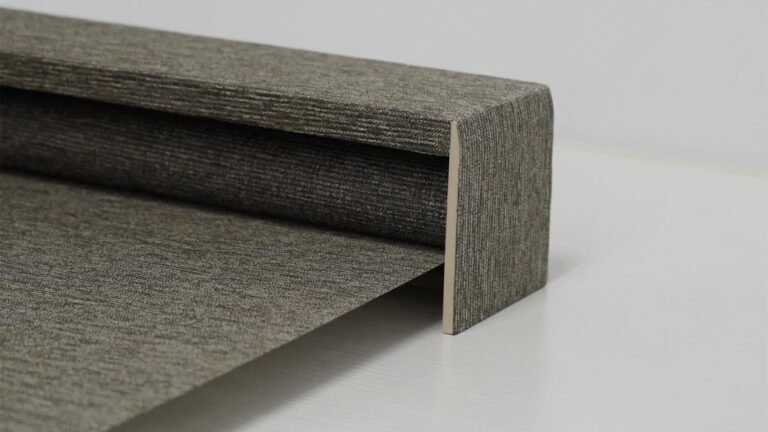
Dimensional scale changes the physics. A 2,400mm-wide roller blind exerts significantly different tube deflection forces than a 1,200mm residential unit. A 38mm aluminum tube — appropriate for residential — will deflect visibly at 2.4m width under fabric weight, producing uneven rolling that worsens with every cycle. Our commercial specification moves to a 45mm tube at widths above 1,800mm, and 53mm above 2,800mm. This detail is not optional; it's what determines whether the product still operates smoothly in year three.
The Five Specifications That Determine Product Performance
Fabric Type and Openness Factor
Commercial roller blind fabric falls into three functional categories. Specifying the category is not sufficient — specify the openness factor.
Blackout fabric (0% openness) is the right choice for hotel rooms, AV spaces, and meeting rooms with presentation screens. If you specify blackout fabric without specifying a side channel or cassette system, you will get light leakage at the edges regardless of fabric quality. Genuine 0% blackout requires both the fabric and the hardware system to address edge gaps.
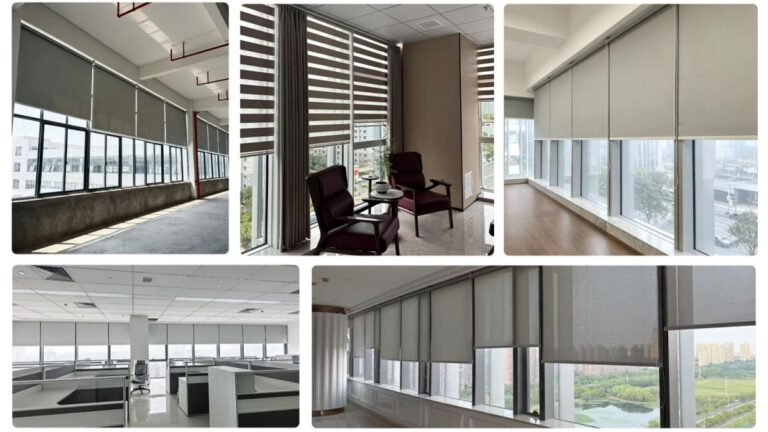
Sunscreen fabric (1–10% openness) is the correct choice for offices where glare control and view preservation both matter. 1–3% openness is appropriate for south and west-facing facades; 5–10% for east-facing and lower-sun-angle applications. The openness factor number is the percentage of the fabric surface that is open — it directly determines how much solar heat and UV enters the space.
Light-filtering fabric (10–30% openness) diffuses light without blocking the view and is appropriate for corridors, reception areas, and spaces where daylight quality matters more than glare control.
Fabric Weight
Specify minimum fabric weight in g/m² in your purchase order. Do not leave it to supplier discretion. Our commercial roller blind fabrics run 280–350 g/m² for standard applications. High-UV-load facades and projects with extended product lifecycle requirements use 380–420 g/m². Lower-weight fabrics pass visual inspection at delivery and underperform within 18 months under commercial conditions.
Tube Diameter
| Blind Width | Tube Diameter | Minimum Wall Thickness |
|---|---|---|
| Up to 1,800mm | 38mm | 1.2mm |
| 1,800–2,800mm | 45mm | 1.5mm |
| 2,800–3,500mm | 53mm | 2.0mm |
| Over 3,500mm | Motorized dual-tube | Custom spec |
Undersized tubes are one of the most common causes of commercial roller blind failure. They're also one of the most avoidable — the table above is not complicated.
Operating System
Chain operation is practical for windows up to approximately 2,400mm where the chain pull point is accessible at a comfortable height. Above that threshold, or in any project with 50+ windows on a single floor, motorization is the better specification — for user experience, for building management system integration, and for maintenance consistency over time.
Our motorized roller systems are compatible with Zigbee, Wi-Fi, and RF control protocols, and integrate with BMS platforms including KNX and BACnet. For LEED-registered projects, automated shading tied to daylight sensors can contribute to energy efficiency credits — your building services engineer can confirm the applicable credit categories.
Certifications
This is where we see the most expensive procurement mistakes. Specifying certifications after an order is placed rather than before means you may be unwinding a purchase order when the wrong test report arrives.
For US and Canadian commercial projects, confirm the following before issuing your RFQ:
NFPA 701 — Fire performance for textiles. Required by most US commercial building codes for window treatments.
California TB 117-2013 — Smoldering ignition resistance. Required for California projects; increasingly adopted by other states and by procurement policies outside California.
GREENGUARD Gold — Low VOC emissions. Required for LEED v4 credits in schools, healthcare, and commercial interiors.
OEKO-TEX Standard 100 — Chemical safety. Not legally mandated but increasingly required by institutional procurement policies and ESG-conscious clients.
ANSI/WCMA A100.1 — Corded blind child safety standard. Required for any installation accessible to children.
All of these are verifiable by test report. Ask for the original report number and cross-check it against the testing laboratory's public database — SGS, Intertek, and Bureau Veritas all provide online certificate verification.
Lead Time Planning
This is where the largest gap exists between what procurement teams assume and what the supply chain actually requires.
| Stage | Realistic Duration |
|---|---|
| RFQ response and technical review | 3–5 business days |
| Pre-production sample | 7–14 days |
| Sample approval (client-dependent) | Variable |
| Production — standard commercial spec | 25–35 days from confirmed PO |
| Sea freight, China to US/Canada East Coast | 22–28 days |
| Customs clearance and last-mile delivery | 5–10 days |
| Total realistic timeline | 65–95 days from RFQ to on-site |
Projects that allow fewer than 65 days from specification sign-off to installation date are at genuine schedule risk. If your project timeline is tighter than this, the conversation about air freight and production prioritization needs to happen at the RFQ stage — not after the purchase order is placed.
What to Include in Your RFQ
A complete commercial roller blind RFQ should include:
- Total unit count and full window size range (width × drop in mm, not imperial)
- Fabric type and openness factor
- Required certifications — list all applicable standards explicitly
- Operating system: chain or motorized; if motorized, control protocol
- Colour direction: RAL number, NCS code, or physical sample
- Batch colour tolerance if consistency across a large run is critical (specify ΔE limit)
- Required delivery date and port of destination
- Packaging requirements: individual cartons, pallet spec, labelling format
- Documentation required: test reports, packing list, certificate of origin, commercial invoice format
The completeness of the RFQ determines the accuracy of the first quote. An incomplete specification produces a quote that requires three revision cycles and a purchase order that arrives with change-order costs attached.
A Note on Quantity Buffers
Order to window count plus a buffer. The right buffer depends on project characteristics:
- Standard project, domestic installation: +5% on total unit count
- Large-scale project (500+ units), international shipping: +7–8%
- Non-standard sizes, complex installation environments: +10%
The cost of having six replacement units in reserve is a fraction of the cost of an expedited air shipment when a panel is damaged during installation on a project with a fixed completion date.
The Point
Commercial roller blind procurement is a specification task, not just a purchasing transaction. Fabric weight, tube sizing, certification requirements, and lead time math are the variables that determine whether a project delivers to schedule without post-installation problems.
Getting these right costs nothing at the specification stage. Getting them wrong costs replacement product, contractor time, and sometimes a failed building inspection.
Published by Shadesmart | Window shade manufacturer, Xiamen China | shadesmart.com