I've spent close to two decades on the production floor of a window covering factory, and I can tell you the difference between a residential order and a commercial order in one sentence: a residential order that goes slightly wrong is a customer service ticket, and a commercial order that goes slightly wrong is a project delay with your name on the change order. Shadesmart is part of Xiamen Goodwood Industry Co., Ltd., founded in 2008, with close to 20 years of window covering manufacturing and export experience, and we run 58,883㎡ of production facilities across 12 dedicated production lines and 93 pieces of professional equipment, producing more than 11 million units a year. That scale tells you we can physically handle a large order. It does not tell you whether we can handle your large order — one where 300 windows across eight floors need to look, move, and last the same way. That's a different question, and it's the one this article actually answers.
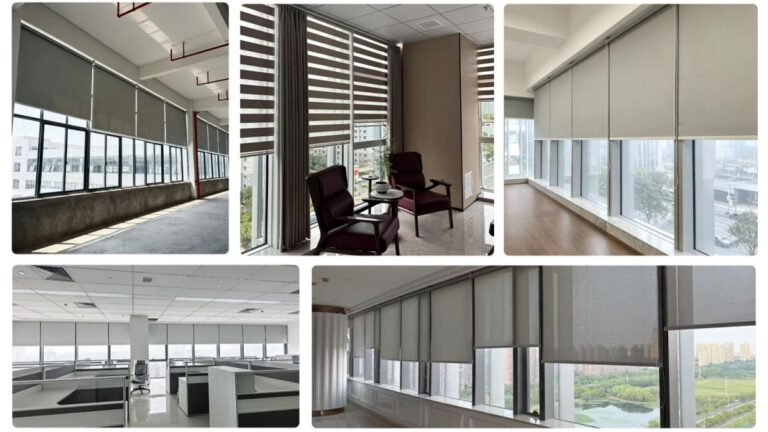
If you're evaluating a commercial roller blinds manufacturer for a hotel, office fit-out, or multi-unit residential project, you're not vetting for "good product." You're vetting for consistency at scale. Here's what I'd actually check.
Why is vetting a commercial roller blinds manufacturer different from vetting a residential supplier?
A residential buyer cares whether one shade works well. A commercial buyer needs every unit in a batch to behave identically, on the same delivery schedule, for years of daily use — which is a manufacturing consistency problem, not a product quality problem.
Residential window coverings tend to ship in small quantities to varied window sizes, and a minor inconsistency between two households is invisible. Commercial and hospitality projects are the opposite: one hotel floor, one office wing, one apartment block typically installs dozens or hundreds of units from the same specification, often in the same visual sightline. A tube that flexes slightly more on unit #40 than on unit #4, or a batch of fabric that reads a shade lighter under lobby lighting, is the kind of thing a homeowner never notices and a project architect notices immediately. The questions below are the ones I'd want a buyer to ask, because they're the ones that actually separate "can produce roller blinds" from "can produce roller blinds at commercial scale without surprises."
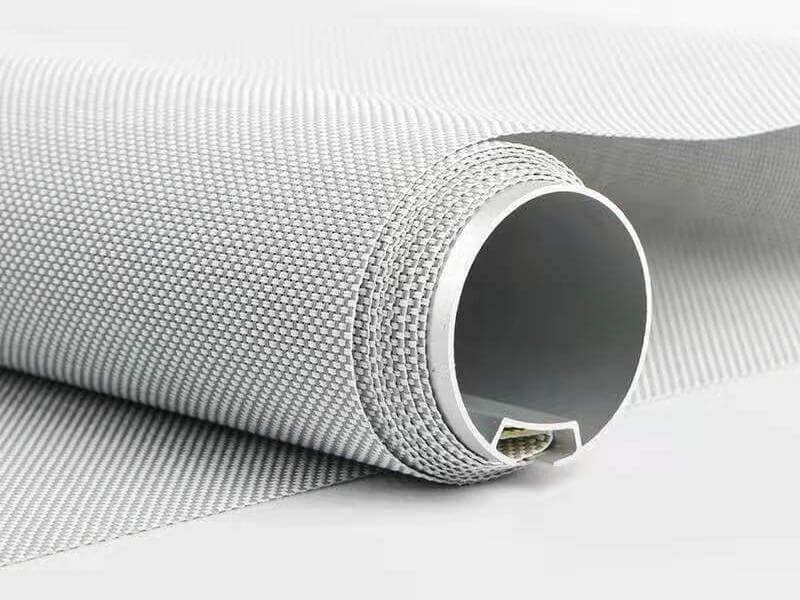
Can the factory's tube and bottom rail engineering handle your window sizes at commercial scale?
Tube diameter has to be selected by fabric weight and width together, not by window size alone — and at commercial widths, the wrong tube produces visible bowing that gets worse over time, not better.
This is the single most common engineering mistake I see in commercial specs, and it's rarely the buyer's fault — it's usually that nobody on the sourcing side was told to ask about it. Here's the internal standard we work to: at 1,800mm width with a 250 g/m² blackout fabric, a 38mm tube produces roughly 4.2mm of mid-span deflection. Below 5mm, that's not visually noticeable. Push a heavier fabric onto the same tube at the same width — a 450g/m² blackout fabric, common in Northern European specs, for example — and deflection can approach 8mm, which reads as a visible bow in the fabric roll when viewed from the side.
Our internal rule is that any roller shade order above 1,800mm width defaults to a 50mm tube on our production line. If a buyer wants to keep costs down by pushing a 38mm tube out to 2,000mm, we'll produce it — but we flag it in writing and require the client to sign off, because our quality team requires that on file. I'd treat that request-for-confirmation step as a good sign in any factory you're evaluating, not a red flag — a factory that lets you spec a tube outside its safe range without comment is one that isn't tracking its own engineering limits.
One detail that surprises a lot of commercial buyers: aluminum tubes creep under sustained load. A tube that measures 4mm of deflection on day one can measure 6–7mm a year later, simply from the fabric's constant weight. That means a spec that looked fine at installation can start looking wrong 6–12 months in — worth asking your manufacturer how they account for this, not just what today's deflection number is.
Bottom rail weight matters just as much and gets overlooked more often:
| Shade Width | Minimum Bottom Rail Weight | Why |
|---|---|---|
| ≤ 1,500mm | 80–100 g/m | Standard weight holds the shade vertical |
| 1,501–2,200mm | 150–180 g/m | Wider panels lift in airflow without added weight |
| 2,201–3,000mm | 220–260 g/m | Balances fabric tension across a large panel |
| > 3,000mm | Dual bottom rail or 280 g/m+ | A single rail can't hold even tension across the full width |
An underweight bottom rail on a blackout shade is one of the most common commercial complaints we see, and it's rarely diagnosed correctly — a facilities team will assume the fabric is failing when the real issue is the bottom rail lifting 5–15cm in airflow near an HVAC vent, which breaks the blackout seal entirely.
A note on limitation: these deflection and rail-weight figures are our internal production standards, developed from our own manufacturing data — they are not a published industry engineering code. Ask any manufacturer for their equivalent internal standard rather than assuming one exists by default.
Will 300 units still match in color when the project ships?
Color consistency across a batch depends entirely on whether every unit was cut from the same fabric dye lot — and once a project runs out of that lot mid-order, no amount of "close match" fixes it.
Color matching is measured in ΔE (delta E), the CIE 1976 color difference standard1, which quantifies how far two colors are from each other to the human eye:
| ΔE Value | Visual Perception | Practical Guidance |
|---|---|---|
| < 1.0 | Imperceptible to the eye | Acceptable in any same-batch context |
| 1.0–2.0 | Detectable on close inspection | Use with caution across windows in the same room |
| 2.0–3.5 | Visible under normal viewing conditions | Not acceptable in the same room; disclose across rooms |
| > 3.5 | Clearly visible difference | Should never be used within the same project |
Here's a real example from our own production history, and I'm including it because it's the kind of thing that's easy to leave out of a sales pitch. A hotel needed one replacement shade a month before opening, after a room measurement error. The original fabric batch had already sold out, and the replacement was cut from a new batch that came in at ΔE 2.8 — visible under normal light. The hotel didn't catch it until their own quality inspection, and the resulting claims dispute ran for eight months.
That's why, on any project above 30 units, our rule is to lock in fabric from a single machine and dye lot before production starts, and to order roughly 15% more fabric than the project requires so that any damage-related replacements can be cut from the same batch rather than a new one. If you're evaluating a manufacturer for a project of this size, ask specifically whether they reserve batch-matched fabric for replacements — this is the detail that prevents the eight-month dispute, not the initial production run.
Is the operating mechanism rated for how often these shades will actually be used?
Mechanism life is rated in operating cycles, and the difference between a residential-grade mechanism and a commercial-grade one is the difference between an 8-year lifespan and a 30-year one — a gap most buyers never ask about until it's already a problem.
| Mechanism Type | Rated Cycles | Equivalent Household Years |
|---|---|---|
| All-plastic chain gear | 8,000–12,000 cycles | 5–8 years |
| Plastic housing + metal chain gear | 20,000–25,000 cycles | 12–15 years |
| All-metal mechanism | 50,000+ cycles | 30+ years |
Residential export products are typically specced with a plastic-housing-plus-metal-chain-gear mechanism, which is a reasonable balance of cost and durability for household use. Commercial project quotes should be specced with the all-metal mechanism instead — and here's the honest part: most commercial buyers don't ask for this upgrade, and don't think about it, until year eight when the chain breaks in a high-traffic corridor and someone has to explain the maintenance budget. If your project involves an office corridor, a hotel corridor, or any space where the shade gets operated multiple times a day by different people, the operating cycle rating matters more than almost any other spec on the sheet — ask for it explicitly, because it's rarely offered by default.
What should you ask to confirm the factory can actually deliver at this scale?
A commercial-capable factory should be able to walk you through its inspection checkpoints and its production capacity in specific terms — not just assure you it can "handle large orders."
A few concrete questions worth putting to any commercial roller blinds manufacturer before you sign:
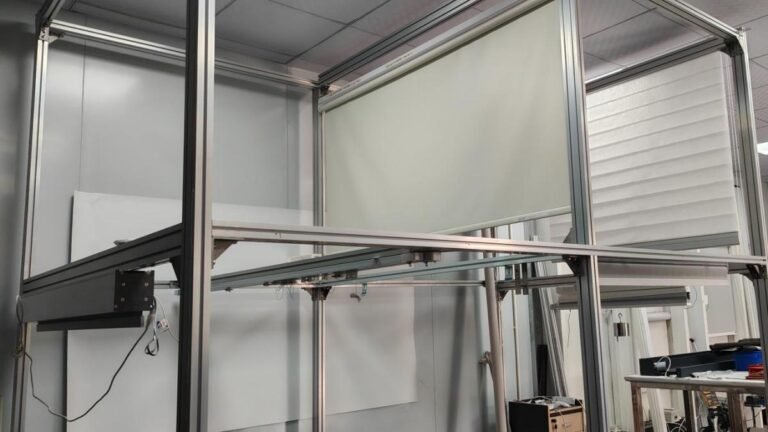
- What does your inspection process actually check, and at what stage? Our own process runs four checkpoints: incoming material inspection (dimensions, fabric weight, color match on every batch), in-process inspection (cut width and height tolerance, checked every two hours per line), finished goods inspection (three full extension cycles, operating force, blackout testing on every unit), and outbound inspection (quantity and labeling accuracy on every shipment). A 16-person dedicated QC team runs 100% finished-goods inspection on our line — ask whatever factory you're evaluating what their equivalent looks like, and whether it's 100% or sample-based.
- How do you handle batch consistency on orders above roughly 30 units? (See the color matching section above.)
- What's your default tube and bottom rail spec above 1,800–2,000mm, and will you flag it in writing if I ask for something below that default?
- Do you offer tiered customization for project-specific requirements? Our own structure runs three tiers — light customization (size and color adjustments), sample development (prototyping and functional validation), and deep customization (structural development, material optimization, and dedicated design) — which maps reasonably well to how most project specs evolve from initial concept to final production run.
None of these questions have a "correct" one-word answer. What you're really testing is whether the factory can explain its own process in specifics, the same way I've tried to do above — a manufacturer that can only answer in generalities ("we have strict quality control") is telling you it hasn't had to explain this to a commercial buyer before.
If your project is a hotel, office build-out, or multi-unit property and you want to walk through batch consistency specs against your actual timeline, confirm batch consistency specs for your project — that's the conversation worth having before the PO, not after.
For the fuller picture of how to evaluate a window shade manufacturer in general — including how to tell a manufacturer from a trading company and how to verify production claims — see our complete guide to choosing a roller shade manufacturer.
Frequently Asked Questions
What tube diameter should a commercial roller blind use for large windows? It depends on both width and fabric weight together, not width alone. As a general internal standard, widths above 1,800mm should move from a 38mm tube to a 50mm tube to keep mid-span deflection under 5mm — ask your manufacturer for their specific threshold and whether they'll confirm it in writing.
How do manufacturers keep color consistent across a large commercial order? By cutting the entire order from a single fabric dye lot before production starts, rather than pulling from stock as needed. For orders above roughly 30 units, ordering extra fabric (commonly around 15% more) from that same lot covers replacements without introducing a color mismatch later.
What's the difference between residential-grade and commercial-grade roller blind mechanisms? Primarily operating cycle life. A standard plastic-housing mechanism is rated for roughly 20,000–25,000 cycles (12–15 household years), while an all-metal mechanism is rated for 50,000+ cycles — the difference that matters in high-traffic commercial corridors where the shade is operated multiple times daily.
Do commercial roller blinds need a different quality inspection process than residential ones? The inspection stages are usually the same — incoming materials, in-process, finished goods, and outbound — but commercial buyers should specifically confirm whether finished-goods inspection is 100% or sample-based, since a single undetected defect in a 300-unit project is far more costly than in a small residential order.
Should I request a written confirmation if I want to reduce tube size below the manufacturer's recommendation? Yes. A factory that requires written sign-off before producing outside its recommended engineering range is documenting the decision for both sides — that's a sign of a quality process working as intended, not an obstacle.
This is the original 1976 formula still widely referenced for basic color-matching tolerances, though newer formulas offer more perceptual accuracy for complex cases. ↩